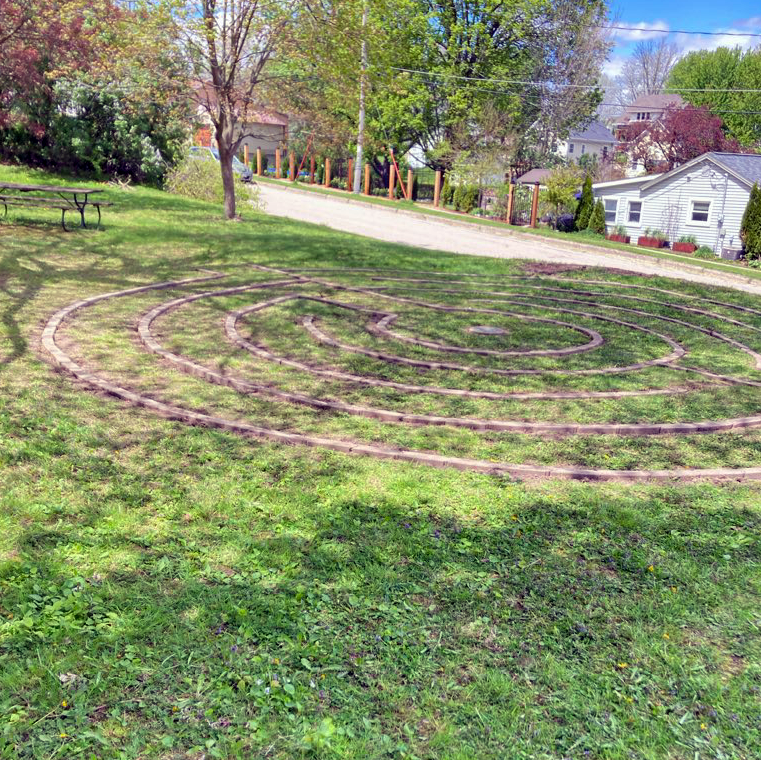
The Trinity Labyrinth was created in 2014 by Justice Hendrick of Boy Scout Troop 337 as his Eagle Scout project. Located at the corner of Church Street and Iowa Street on the site of a former tennis court, the labyrinth is open to all people seeking a quiet place for reflection, prayer, meditation, or peaceful walking. Read a story about its revitalization in the diocesan news here. Download the brochure here.
Walking the labyrinth is not about getting lost.
It is about finding stillness, purpose, and presence along the way.
WHAT IS A LABYRINTH?
A labyrinth is an ancient spiritual tool that has been known for more than 4,000 years. Unlike a maze, a labyrinth has a single winding path leading to the center and back out again. Across many cultures and faith traditions, labyrinths have been used as places of prayer, contemplation, healing, and renewal.
TRADITION ACROSS CULTURES
Labyrinths appear in many spiritual traditions throughout history, from the famous labyrinth at Chartres Cathedral in France to sacred paths and prayer journeys found around the world. Though traditions differ, the purpose is often the same: to seek peace, wisdom, healing, and connection with the divine.

WALKING THE LABYRINTH
Walking the labyrinth is often described as “prayer in motion.” There is no right or wrong way to walk it. Each journey is personal.
Before You Begin
Pause quietly at the entrance. Consider a prayer, hope, concern, gratitude, or person you wish to hold in your thoughts.
Follow the Path
Walk at a comfortable pace. The path twists and turns, much like life itself. Notice your surroundings, your breathing, and the rhythm of your steps.
Pause at the Center
Rest quietly in the center. Reflect, pray, or simply be still.
The Return Journey
As you walk outward, carry your thoughts and reflections with you. Many people find the return path brings clarity, peace, or renewed perspective.
Give Thanks
At the end of your walk, take a moment to give thanks for the experience and the time set apart from daily life.


 Trinity Episcopal Church, Mineral Point, Wisconsin